De Angelis
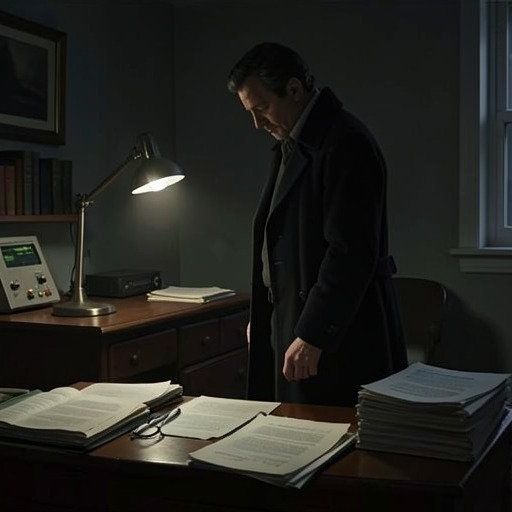
Foucault's PendulumDe Angelis is the Milan inspector assigned to the political dimension of Colonel Ardenti’s disappearance. He is a practical investigator who tests what Casaubon and Belbo know against the uncertain evidence in the case; his inquiries also bring the colonel’s missing documents and a séance that echoes Ardenti’s claims back into the novel’s growing web of interpretation.
Identity and Introduction
De Angelis introduces himself to Casaubon and Belbo at the hotel room rented under the name Colonel Ardenti. Fairly young, with fairly long hair, he identifies himself by name and addresses Belbo as a doctor. When Casaubon clarifies that he is still working toward his degree, De Angelis encourages him to finish it, adding that a degree is necessary to take the police examinations. The casual advice gives way quickly to official business: he shows them the passport belonging to the room’s renter and asks whether they recognize the man.
The room offers no secure account of what happened. The police have found no corpse, only signs that someone searched the disordered furnishings. De Angelis considers several possibilities: the two men last seen with Ardenti may have taken a body out by way of the courtyard; they may have left while others were away seeking help; or there may never have been a body, since one witness, an old alcoholic, has a history of seeing things that were not there. De Angelis distinguishes what the police can establish from what remains speculation: the room has been searched, and Ardenti is missing.
The Investigation into Ardenti
A slip of paper found beside the small table gives De Angelis a concrete lead. It lists an appointment with Rakosky at the Hotel Principe e Savoia at two in the afternoon and another with Garamond and Dr. Belbo at four. De Angelis notes that Ardenti had apparently met Rakosky without telling him he was going to see Belbo. The omission matters because the sequence places Rakosky near the disappearance while leaving the purpose of the meetings unknown.
De Angelis also tests the physical details. Ardenti’s passport and a large amount of money remain in his jacket, making robbery an unlikely explanation for the search. Belbo says Ardenti carried a brown briefcase; Casaubon remembers it as red. The discrepancy does not solve the case, but it points toward the importance of the documents they had seen and cannot describe with confidence. De Angelis asks what those documents looked like, trying to turn their recollections into something usable rather than accepting the vague assertion that Ardenti possessed papers.
The investigation has shifted from homicide to political police. De Angelis explains that a homicide colleague initially handled the matter, then passed it to him after more information about Ardenti emerged from the records. He admits uncertainty about whether he is the right person for the case and rejects the neat resolution of detective fiction: life, he says, is not simple in that way. His uncertainty is not an absence of method; it marks the limits of what the available evidence can prove.
Casaubon and Belbo Under Question
De Angelis’s questioning makes the two researchers confront their own conduct. They have concealed information from the police, and as they leave the hotel Casaubon recognizes that both he and Belbo have lied. Although De Angelis seems friendly and explicitly says he does not regard all students as criminals, his presence turns their private involvement with Ardenti into something legally and morally uncomfortable.
He returns to that pressure a year later, when Casaubon encounters him at a séance. Casaubon has moved toward a girl who, while in a trance, spoke of six seals and a long wait—details that recalled Ardenti’s account. De Angelis stops him from approaching her, saying that he knows where to find her, then asks what Casaubon was doing there and why he wanted to speak to her. Casaubon resents being treated as a suspect, but De Angelis explains that the police have tried to reconstruct Ardenti’s last two days in Milan. By chance, they learned that someone had seen Ardenti leaving the Picatrix offices with the psychic girl.
The exchange exposes a weakness in Casaubon’s earlier testimony. De Angelis observes that Casaubon remembers the phrase about six seals clearly, although when questioned before he had described Ardenti’s remarks only vaguely as talk about Templar treasure. Casaubon argues that he did not consider the seals important, since treasures are ordinarily imagined as sealed. De Angelis presses the inconsistency without claiming that it proves guilt. His role is to keep the distinction between a suggestive resemblance and a reliable recollection visible, even as Casaubon increasingly treats such resemblances as clues.
Narrative Role
De Angelis supplies a grounded counterpoint to the researchers’ speculative reconstruction. He works from a missing body, a searched room, a slip of paper, contradictory memories of a briefcase, and a witness whose reliability is doubtful. His questions repeatedly return the story to what can be established and what remains conjecture. Yet the investigation cannot settle Ardenti’s fate: the colonel remains missing, and even the most suggestive leads do not disclose what happened to him.
His appearance at the séance brings police procedure into contact with the novel’s atmosphere of occult pattern-making. De Angelis knows the psychic girl through the investigation, while Casaubon hears her words as confirmation of Ardenti’s message. The difference between those approaches does not make De Angelis omniscient or the séance meaningless; it shows how the same fragment can function as a lead to an investigator and as apparent revelation to someone already absorbed by the Plan. De Angelis’s restrained skepticism therefore helps preserve the unresolved tension between evidence and interpretation.